Guadalupe County Court Houses
1847 | 1856 | 1883 | 1936
(The material for this summation of the four court houses of Guadalupe County was gathered from the Commissioners' Minutes, Books A, B, B1, through G, from Bishop Fitzsimon's Centennial Record, and Miss Jennie Hollamon's Notes.)
by Leonie Pape
Before there was a Guadalupe County, and before a Court House was built, the first court trials in Seguin were held under Trees when weather permitted, and in private homes. Certain Spanish Oaks were of importance in the field of judicial service. The trees at the Chamber of Commerce office building were named the Jury Trees. The large Oak in the yard of the Nolte Starcke Home is known as the Charter Oak, and the "Hanging Tree" still stands at the southeast corner of the former Plaza Hotel Building. Records state that the first court trials were held in the home of Thomas D. Spain.
FIRST COURT HOUSE 1847
March 30, 1846, the Texas Legislature approved the Act creating Guadalupe County, and it was then that the Guadalupe County Court was organized. According to the Commissioners' minutes, 1847, it was ordered by the Court to appoint H. G. Henderson, J. S. Calvert, and William Tom to make plans to build a Court House. It was to be on the site of Public Square in the town of Seguin. The committee was to take up subscriptions from citizens of the county and to advertise for proposals to build a Court House upon faith of said subscriptions. Unappropriated funds of the county were to be used for additional sum for the building. Michael Erskine was Chief Justice of the County Court at the time.
The building committee consisted of Andrew Neill, J. S. Calvert, and H. G. Henderson. E. M. Cox and William Lancer were given the contract for $1,056.00. Some additions brought the contract to $1,400.00. Thomas D. Spain and Peyton Medlin were the builders. The Court House was a two-story lumber structure. Its dimensions were 30 feet by 40 feet. The upper floor was used for Court rooms. The lower floor was divided into four rooms for county offices.
Citizens of the county contributed liberally and evidenced a desire and willingness to have the Court House finished, or at least painted and furnished by May, 1848. J. S. Calvert, John King, and Andrew Neill were appointed to oversee the painting and the purchase of furniture .. In due time the first Guadalupe County Court House was occupied.
By 1853 the Court ordered to buy a vault in which to store valuable papers. In 1854 the Court ordered to paint the Court House three coats of pure lead and oil, and to paint doors, windows, and shutters a chocolate brown color. This for the sum of $85.00.
SECOND COURT HOUSE 1857
After eight years, the 1847 frame Court House was bulging, and in 1856 the contract for that fabulous new two-story concrete affair with guilded but leaking cupola was let. The building committee consisted of I. J. Caruthers, J. M. Bren, and A. B. Moore. The contract for the second Court House was given to Ezra Keyser, May 21, 1856, for the sum of $10,000.00. It was to be built on the town square. This necessitated the removal of the old Court House. The Sheriff was ordered to sell at Court House door the old building to the highest bidder on credit of one to two year equal payments, reserving all furniture. The purchase to be within ten days for the removal of the building.
July 1857, the old Court House was sold to J. R. Johnston, I. L. Calvert, and John M. Fenner for $780.00. It was removed to the northwest corner of Court and River Streets. A score of oxen were used for this purpose to drag it to its new site where it served as a mercantile business for Johnston and McNealy and other firms until it was purchased by Eric Hey, 1906.
May 4, 1907, occurred the first great fire in Seguin, which destroyed almost the entire row of buildings north of the Court House, including the old court house building which had been remodeled by Hey. It was rebuilt and later became Hey's M System.
During the construction of the Court House, offices were moved to the Ezra Keyser concrete building on the east side of the public square. It was partitioned so as to separate the Clerk's office from the Court Room.
The second Court House was a two-story structure 64 feet by 40 feet, built of concrete, each story 12 feet high. The outer walls of lower floor were 18 inches in thickness and those of the upper story 14 inches. The roof was of tin. The foundation was dug down to solid gravel or rock. The outer walls were 2 feet above ground. The lower flooring of the building was made of cut stone in blocks of equal size, two feet in thickness. All other floors were of pine, two and one-fourth inches thick, grooved, dressed, and tongued. There was a large front door with transom light, a large back door at end of passage running through building, and an outside door at each end of hall running across the front of the building. Two flights of stairs ran up in the front passage or hall to upper floor. The stairway was four feet wide; the railing or banisters of pine. Two flues commenced near the middle of the lower rooms and ran up on each side of house and finished with chimneys a foot and a half above roof. The building was plastered inside except the passage on lower floor which was penciled to represent blocks. The Court House was enclosed with a good concrete fence, one foot thick and four feet high. There were four gates, one at each corner of the yard.
July 1857, a large number of county citizens petitioned the Court for changes in the plans for the new Court House building. The following changes were approved:
- (1) Instead of tin roof, to have a cypress shingled hipped roof;
- (2) House to be built two rounds higher than contract called for;
- (3) A cupola or steeple to be built according to drawing of Erkels. The Court to pay as follows: $250.00 for changing roof and for extra concrete; $730.00 for the cupola. Shutters were to be on windows of new Court House.
George Erkel and Fred Fritz were authorized to build a privy on the northwest corner of Court House yard under oaks--10 feet by 12 feet and 9 feet high, with two doors, two seats, plank petition, shingled roof, walls of concrete. The cost $100.00.
The Court received and approved the completed Court House August, 1858. Henry Maney was the Chief Justice at that time. In one of the writings of Miss Jennie Hollamon, who has left many interesting sketches and descriptions of persons and places in those days, gives the following description of Guadalupe County's Second Court House: "It was of concrete with walls finished in stucco. The Judge's stand, nicely enclosed in an elevated railing, showed an advance. Outside the walls were tinted blue; the cupola was surrounded by several gilded balls, and it presented quite an imposing appearance."
During 1858-1859 further improvements were made in and around the Court House. Hy. Maney was ordered to buy carpet and twenty-five chairs for District Court room. (Several of these chairs are now in possession of The Seguin Con3ervation Society.) The 0ffice of County Surveyor was established. Lightning rods were put on the Court House. The Sheriff was ordered to take charge of the second floor and allow no one outside of County offices to use it except for religious purposes. By 1861 this privilege was no longer granted. The Sheriff was appointed to lock Court House each evening and to open it each morning. Seemingly leaks were constantly appearing around chimneys, gutters, and cupola. Almost constant repairs were needed to maintain the structure.
During the Civil War years the County Court was involved in making provisions for men going into service of the Confederate States. A War Tax was levied for the support of families--15¢ on one hundred dollars valuation. Chief Justice H. P. H. Douglass resigned to enlist in military service. James McClaugherty, sheriff resigned and was appointed Chief Justice. When the enemy bombarded Galveston, Seguin invited families to this county. $2,500.00 was spent for cloth for soldier's families. Corn and bacon was taken by the County on script.
1866 the name of Chief Justice of the court was changed to that of County Judge. April 1869 the county paid 80¢ per tree for 118 trees to be planted on Court House yard.
1874 the following repairs were needed in Court House: a new plank ceiling in large room and passage on second floor; the stone floor in lower story to be replaced with plank flooring; repair plastering where needed.
April 1876 a new constitution of Texas went into effect establishing a new Court, called "County Commissioner's Court."
1877 a brick vault was built in Court House. G. Stautzenberger was paid $5.00 for 10 benches.
1879 bid for tin roof for Court House was given to Bledsoe & Winter.
The name of George Coleman appears many times in court minutes. He was the janitor at a salary of $10.00 per month.
1881 a well was dug and windmill erected at the southeast corner of Court House yard. Two underground cisterns were built, one at the east and one at the west side of Court House. The water supply was for protection against fire.
THIRD COURT HOUSE 1883
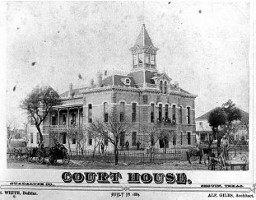
During the years from 1870-1880, the population of Guadalupe County increased from 7,263 to 12,202. The County Court House became too small for the increasing volume of business and in August 1882, Alfred Giles, architect, was paid $100.00 for making sketches for remodeling and enlarging the building. In May 1883, Steve White was given the contract for the improved Court House for $21,750.00. In June of the same year, Giles suggested the use of red clay brick, which were made south of Seguin, for the new addition to Court House. An extra $1,700.00 was ordered added to the contract, bringing it to $30,000.00. J. Miller was appointed to superintend the brick work.
The contract with White required the raising of old Court House four feet; to build the roof self-supporting; to put new frame and casings in windows of old section of building. The Court ordered warrants to be issued at the rate of 8% to be used to pay annually on the $30,000.00 needed for the building. Later when extra money was available from state school funds, the warrants were cancelled.
The Commissioners' Court voted to move offices to the Odd Fellows Hall until Court House was completed. The Hall was the second-story of the Joshua Young store which stood on the northeast corner of Austin and Court Streets. In 1906 The First National Bank was erected on this corner. Today the County Tax office occupies the lower area of the building. Other places were rented for office spaces: John Ireland's office; Mrs. Koehler's house; J. W. Graves hall.
By March 1884 the Court House was completed and accepted by the Commissioners. New furniture was purchased from J. John Furniture Company. $79.00 was expended for chandeliers. Lightning rods were bought from Philip Vivroux. The Court House was insured for $20,000.00 by Joseph Zorn, Insurance Agent. The following salaries were paid some of the county officers: County Judge $300.00; Sheriff $300.00; County Clerk $250.00. W. P. H. Douglass was Judge at the time.
1892 Ed. Barth received the contract to paint inside and outside of Court House. A new iron fence was placed on rocks around Court House yard. This same year bids were received for a pauper farm. C. M. Holmes had established a waterworks system on the Guadalupe River and the County Court contracted with Holmes to lay water lines to the Court House and Jail. Wells on the Court House yard were still used in 1907.
A cement curb and galvanized hitching rack was erected around Court House yard. Jos. Sonka received the bid for sixty-five cents per lineal foot. 1914 the Court ordered the County Clerk to make a general index of all marriage licenses. No general index had been kept. $1.50 was paid for sprinkling around the Court House.
FOURTH COURT HOUSE 1936
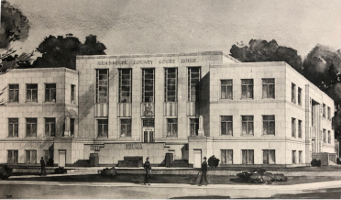
By 1934 plans were begun for a new Court House. The old building was sold to George J. Sowell for the sum of $125.00. The buyer was required to clear everything from the grounds - even all mortar. The following items were retained: all furniture and fixtures in the entire building, including chairs connected to the floor; window shades; electric light drops; five doors, two laboratories; two toilets; two vault doors, district judge's bench; one window.
L. M. Wirtz of Austin, Texas was employed as architect, and A. W. Harris was the consulting architect. The contract was dated August 13, 1934. This was under P W A Docket No. 4500.
March 1935 the County Court accepted the bid of K. B. Key of San Antonio, Texas for the sum of $139,062.75. The contract included plumbing, electrical work, vault doors, and furniture. The building was to be built of steel, concrete, tile, and stone. A new jail was built at the same time. Albert Nolte received the contract for the sum of $36,421.00.
During the building of the Court House, offices occupied the following buildings of Seguin: The court rooms were moved to the W. J. Blumberg building on the southeast corner of Gonzales and River Streets; the Collector, Assessor, and District Clerk offices occupied the Citizen's State Bank building on the southwest corner of Austin and Gonzales streets.
Courthouse Today

The Court House building as we see it today (2018) was completed and occupied April 1936. Mr. Herman Heideke was County Judge. Many modern conveniences have been added to the building during the years.
Although some of the early courthouse occupants have moved to the Guadalupe County Justice Center 2 blocks East, The Guadalupe County Courthouse is still occupied and used today.